
Dhammapala Jataka
Dhammapala Jataka
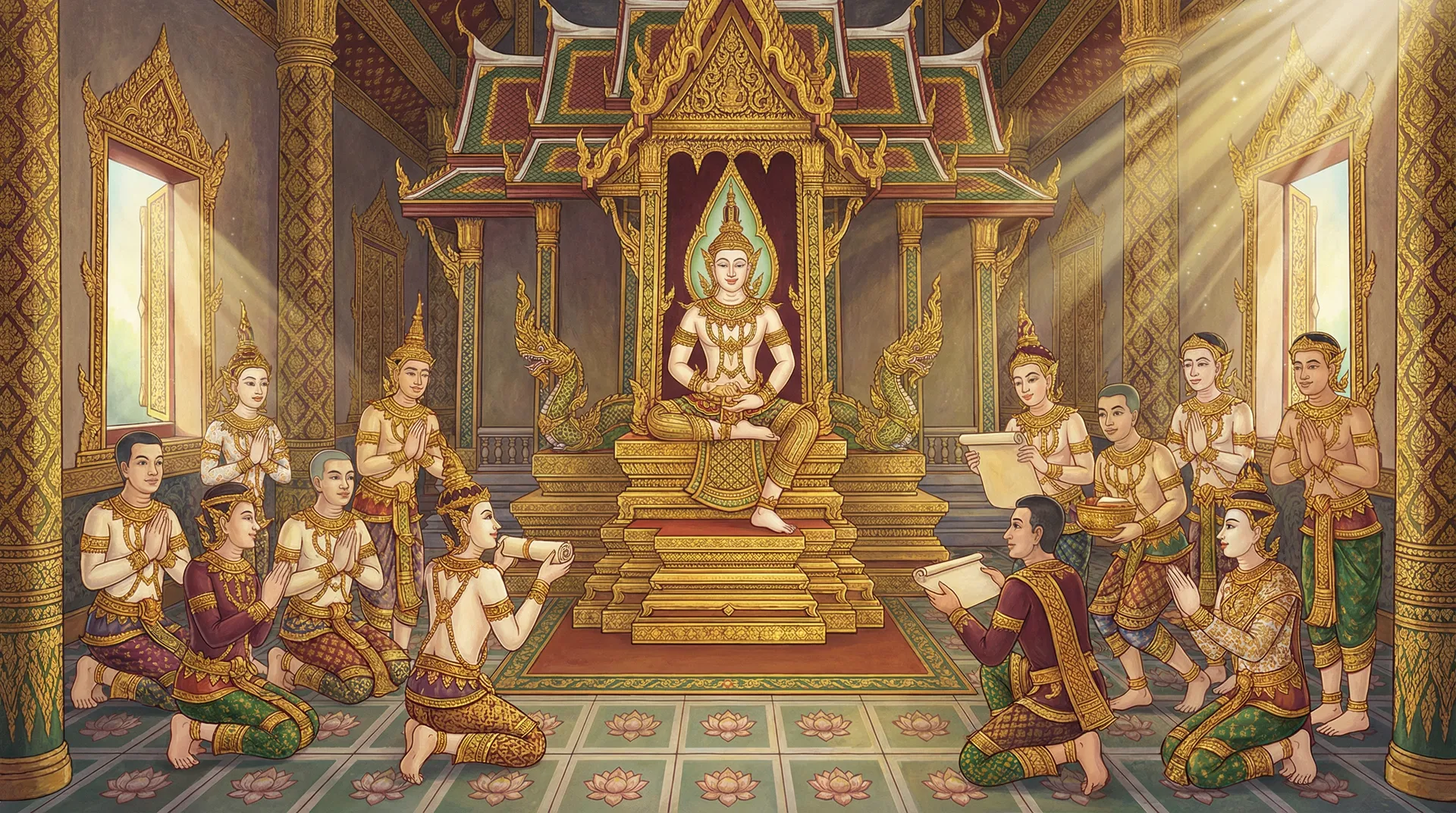
In the ancient and prosperous city of Varanasi, lived a king named Brahmadatta, a ruler renowned for his wisdom and justice. Yet, even the most righteous kings can fall prey to the whispers of envy. The king's chief queen, a woman of striking beauty and a heart as dark as the deepest well, harbored a bitter jealousy towards her husband's favorite consort, Queen Uttaradevi. Uttaradevi was not only beautiful but also possessed a gentle spirit and a keen intellect. The chief queen, consumed by her envy, plotted to eliminate Uttaradevi from the king's favor.
One day, during a grand royal feast, the chief queen approached the king, her face a mask of feigned concern. 'My lord,' she began, her voice laced with a subtle tremor, 'I have a secret burden that weighs heavily upon my heart. I fear for your safety, and indeed, for the safety of the kingdom.'
King Brahmadatta, always attentive to his queen's words, leaned closer. 'Speak, my dear. What troubles you so?'
'It is Queen Uttaradevi,' the chief queen whispered, her eyes darting as if to ensure no one overheard. 'I have seen her consorting with a shadowy figure in the palace gardens at night. She speaks in hushed tones, and I fear she may be involved in dark sorcery, perhaps even plotting against your life.'
The king, though usually discerning, was momentarily swayed by his queen's dramatic tale. He loved his chief queen and, in his desire to protect himself and his kingdom, decided to investigate. He ordered his most trusted spies to discreetly watch Uttaradevi.
The spies, eager to please, observed Uttaradevi. They saw her, as the chief queen had described, meeting someone in the garden under the cloak of darkness. They reported back to the king, their accounts embellished with fearful speculation. The king's suspicion grew into a conviction. He ordered Uttaradevi to be brought before him.
When Uttaradevi stood before the king, her eyes wide with confusion and hurt, the king accused her of treason and sorcery. 'How dare you betray my trust, Uttaradevi? How dare you conspire against my life?' he boomed.
Uttaradevi, a woman of immense inner strength, did not cower. 'My lord,' she replied, her voice clear and steady, 'I have done nothing to betray you. My nightly meetings were not with a shadowy conspirator, but with a wise ascetic who resides in the forest bordering our kingdom. He imparts to me knowledge and guidance, not for my own gain, but to help me serve you and our people better.'
The king remained unconvinced. 'An ascetic? In the dead of night? Your story is a fabrication to cover your treachery!'
Just as the king was about to pronounce a severe punishment, a young boy, no older than ten, stepped forward from the gathered crowd. This was Dhammapala, the son of Uttaradevi and King Brahmadatta himself, though the king had not recognized him in his anger. Dhammapala, even at his young age, possessed a wisdom far beyond his years. He had overheard the accusations and his mother's plea.
'Father!' young Dhammapala cried out, his voice ringing with authority. 'You are mistaken. My mother speaks the truth. The ascetic she meets is indeed a noble sage, and I myself have accompanied her on these journeys. She seeks wisdom to better rule, not to harm.'
The king was taken aback. He looked at his son, who stood before him with an unwavering gaze. 'You, Dhammapala? You have seen this?'
'Yes, father,' Dhammapala replied. 'My mother's heart is pure. It is the chief queen who is filled with malice. She fears my mother's virtue and wisdom, and seeks to cast her out.'
To prove his point, Dhammapala proposed a test. 'Let us summon this ascetic. If he is truly wise, he will know the truth. And let us also reveal the chief queen's true intentions. I believe the ascetic can help us with this.'
King Brahmadatta, intrigued by his son's conviction, agreed. He sent his messengers to the forest to find the wise hermit. Meanwhile, Dhammapala, with the king's permission, went to the chief queen's chambers.
In the chief queen's chamber, Dhammapala confronted her. 'Your lies have almost cost my mother her life. But the truth will prevail.' He then asked her a series of riddles, testing her knowledge and her intentions. The chief queen, arrogant and foolish, could not answer even the simplest of them. Her silence and her evasiveness confirmed Dhammapala's suspicions.
When the ascetic arrived, he was a man of serene countenance and profound wisdom. The king presented him with the accusations against Uttaradevi. The ascetic listened patiently and then, looking directly at the chief queen, spoke, 'The darkest shadows often hide the most deceitful hearts. True wisdom is found in compassion and truth, not in schemes and lies.'
The ascetic then revealed the chief queen's malicious plot, explaining how she had manipulated the king with false accusations. He detailed the chief queen's envy and her desire to usurp Uttaradevi's position. The chief queen, exposed and ashamed, could not deny the truth.
King Brahmadatta, realizing his grave error and the true virtue of his wife and son, was overcome with remorse. He banished the chief queen from the kingdom and reinstated Uttaradevi to her rightful place, showering her with love and gratitude. He praised his son, Dhammapala, for his courage and wisdom, recognizing him as a future pillar of the kingdom.
From that day forward, King Brahmadatta ruled with even greater wisdom, always remembering the lesson learned: that true judgment comes not from fleeting suspicion, but from seeking the truth with an open and discerning mind. Uttaradevi, with the support of her wise son, continued to be a beacon of virtue and wisdom in the kingdom, and Dhammapala grew to be a just and compassionate ruler, always upholding the principles of truth and righteousness.
— In-Article Ad —
💡Moral of the Story
Envy and deceit can lead to grave misunderstandings and suffering, while truth, courage, and wisdom will ultimately prevail, exposing falsehood and restoring justice.
Perfection: Wisdom (Prajna Paramita)
— Ad Space (728x90) —
More Jataka Tales You May Enjoy
 519Vīsatinipāta
Temiya Jataka
The Prince Who Found Joy in StillnessIn the ancient city of Ujjeni, amidst the grandeur of a royal p...
💡 True happiness and liberation are found in detachment from worldly possessions and transient pleasures. Understanding the impermanence of all things leads to inner peace and freedom from suffering.
149EkanipātaTemiya Jataka
Temiya JatakaIn the opulent kingdom of Sankhapura, a kingdom renowned for its splendor and its flour...
💡 True freedom and peace are found not in worldly possessions or power, but in detachment from impermanence and the realization of the true, eternal nature of the self.
 256Tikanipāta
Kaccābarāva Jātaka
Kaccābarāva JātakaIn the ancient land of Mithila, where rivers flowed like silver ribbons and forest...
💡 The greatest strength lies in selfless sacrifice for the well-being of others.
 250Dukanipāta
Sasa Jataka
Sasa JatakaIn a time long past, when the world was young and the forests were vast and untamed, ther...
💡 The greatest gift one can offer is oneself, given freely and with boundless compassion, for the benefit of all.
275TikanipātaKusa Jataka
Kusa JatakaIn the opulent city of Varanasi, amidst a kingdom blessed with abundance, lived a king re...
💡 True wealth lies not in material possessions or worldly power, but in inner contentment, detachment, and wisdom, which bring lasting peace and freedom from suffering.
182DukanipātaBhisa Jātaka
The Tale of the Water Lily SeedLong ago, in the vibrant kingdom of Kashi, there reigned a just and c...
💡 Sustainable prosperity and success are achieved through patience, meticulous care, and understanding the specific needs of a situation, much like nurturing a delicate plant. Hasty actions and neglect of fundamental conditions lead to failure.
— Multiplex Ad —